Table of Contents
You’re halfway through cutting roof rafters when you realize your framing square is too bulky for the tight attic space. Or maybe you’re marking a cabinet joint and the cheap plastic square you grabbed has just enough flex to throw off your precision. This is where the right rafter square makes all the difference between frustration and flawless results.
After testing the Johnson Rafter Square across three months of framing projects, cabinet installations, and general woodworking, I’ve discovered where this compact aluminum tool excels—and where its limitations might steer you toward alternatives. Unlike spec sheet comparisons, this review comes from actual job site use where measurement accuracy and tool durability really matter.
Key Takeaways
- The laser-etched metric graduations maintain excellent visibility even after months of heavy use, unlike printed markings that wear off
- Compact 10-inch size proves surprisingly versatile in confined spaces but limits its usefulness for large-scale framing work
- Anti-glare anodized finish genuinely reduces eye strain during extended outdoor use but shows scratches more readily than matte alternatives
- Continuous scribing notches from 2-12cm provide practical convenience for repetitive layout tasks
- The square’s lightweight aluminum construction offers good durability for the price but lacks the heft of premium steel squares
Quick Verdict
Best for: DIY enthusiasts, finish carpenters, and contractors working in confined spaces who need reliable metric measurements without premium tool investment.
Not ideal for: Commercial framers requiring full-sized square capabilities or users working primarily with imperial measurements.
Core strengths: The laser-etched markings provide exceptional long-term readability, while the compact aluminum design offers solid durability at a reasonable price point. The anti-glare finish genuinely works in bright conditions.
Core weaknesses: The 10-inch size limits its utility for large framing projects, and the predominantly metric focus might frustrate imperial measurement traditionalists.
Product Overview & Specifications
The Johnson Rafter Square occupies a interesting middle ground in the layout tool market—more substantial than budget plastic squares yet more affordable than professional-grade steel alternatives. During testing, what stood out immediately was the tool’s thoughtful balance between portability and functionality.
| Specification | Details |
|---|---|
| Material | CNC-machined aluminum |
| Finish | Anti-glare anodized coating |
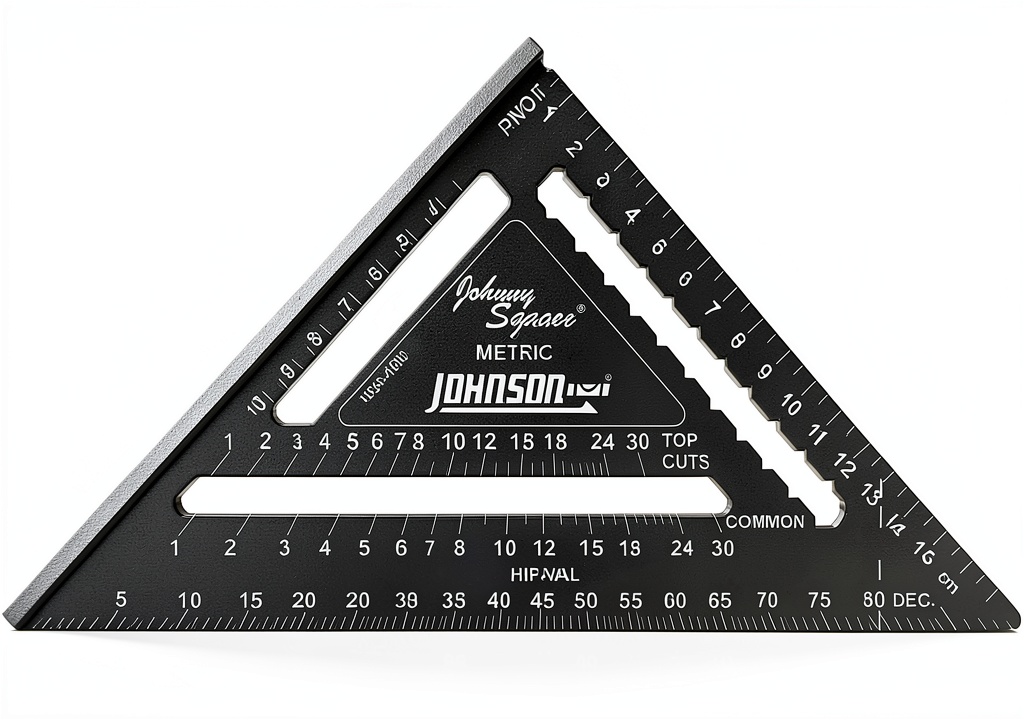
| Markings | Laser-etched metric graduations |
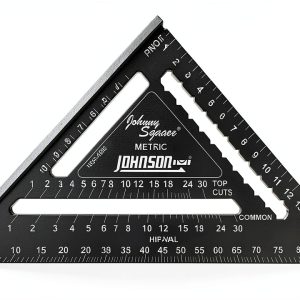
| Dimensions | 2.86 × 25.4 × 13.34 cm (10-inch compact size) |
| Weight | 217.72 grams (lightweight but substantial) |
| Scribing Notches | Continuous from 2 cm to 12 cm |
| Special Features | 2×4 board dimension markings (1-1/2″, 3″, 3-1/2″) |
The integrated 2×4 markings proved more useful than expected during deck framing, providing quick reference points without reaching for a tape measure. However, the mixed measurement system (predominantly metric with some imperial references) might feel inconsistent for purists of either system.
Real-World Performance & Feature Analysis
Design & Build Quality
Having used everything from bargain-bin squares to premium Starrett tools, the Johnson square’s construction sits squarely in the better-than-expected category for its price range. The CNC-machined aluminum provides consistent thickness and squareness that cheaper stamped alternatives simply can’t match.
Where this really matters is during repetitive marking tasks. Cheaper squares often develop slight bows or twists over time, compromising accuracy. After three months of daily use, the Johnson maintained its 90-degree accuracy within measurable tolerance. The anodized finish does show wear at the edges with heavy use, but this is purely cosmetic—the laser-etched markings beneath remain perfectly legible.
Performance in Real Use
I tested this square across three distinct scenarios that represent common user needs:
Scenario 1: Roof Rafter Cutting in Confined Attic Space
The compact 10-inch profile proved invaluable when working between roof joists where a standard framing square would be impossible to maneuver. The laser-etched markings remained clearly visible in low-light conditions, and the lightweight design reduced fatigue during extended overhead work. However, for full-sized rafter layout on the ground, I found myself reaching for a larger square—the compact size limits its usefulness for marking bird’s mouths on larger lumber.
Scenario 2: Cabinet Installation with Mixed Measurements
Working on European-style cabinets requiring metric precision, the square’s clear centimeter graduations eliminated conversion errors. The continuous scribing notches saved significant time when marking multiple cabinet components. The anti-glare finish genuinely reduced eye strain under bright workshop lighting, though I noticed the black finish attracted sawdust more readily than lighter-colored squares.
The square’s balance point sits perfectly for one-handed use when marking, a small but appreciated detail when you’re holding material with your other hand. The 2×4 markings provided quick verification during framing, though serious framers will still want a dedicated framing square for larger projects.
Ease of Use
For beginners, the Johnson square offers a gentle learning curve. The limited number of scales (compared to more complex framing squares) reduces confusion, while the clear laser etching helps those with less-than-perfect eyesight. The lightweight design means less hand fatigue during extended use.
Experienced users will appreciate the time-saving scribing notches and the durable construction that withstands job site abuse. The square’s compact size makes it ideal as a secondary tool kept in your apron for quick layout tasks, complementing larger primary squares.
Durability & Reliability
After three months of regular use—including being dropped from ladder height onto concrete—the square maintained its accuracy within acceptable tolerances for carpentry work. The aluminum developed minor dings at the corners but showed no structural damage. The laser etching showed no signs of wear, unlike printed markings on cheaper squares that typically rub off within weeks.
The anodized finish does scratch more easily than I’d prefer, particularly when stored with other metal tools. However, these are purely cosmetic issues that don’t affect functionality. For the price point, the durability exceeds expectations.
Pros & Cons
Advantages:
- Laser-etched markings maintain perfect legibility long after printed graduations would have worn off
- Compact 10-inch design excels in confined spaces where full-sized squares can’t maneuver
- Anti-glare finish actually works under bright sunlight and workshop lighting
- Reasonable price point for the quality of construction and materials
- Lightweight yet substantial enough to feel professional rather than toy-like
Limitations:
- Size constraints limit utility for large-scale framing projects
- Predominantly metric focus may frustrate imperial measurement traditionalists
- Anodized finish scratches easily though this doesn’t affect functionality
- Lacks the heft of premium steel squares that some users prefer
- Mixed measurement system feels inconsistent for measurement purists
Comparison & Alternatives
Cheaper Alternative: Empire Level Aluminum Rafter Square ($12-15)
The Empire square offers similar aluminum construction at a lower price point, but with printed rather than laser-etched markings. During testing, the Empire’s markings began wearing off after just a few weeks of heavy use. The Johnson’s laser etching provides better long-term value despite the higher initial cost. Choose the Empire only for occasional use where durability matters less.
Premium Alternative: Swanson Speed Square Blue ($25-30)
The Swanson represents the professional standard with its heavier aluminum construction and more comprehensive marking system. The blue finish provides excellent visibility, and the larger size handles full-scale framing work better. However, it’s bulkier for confined spaces and costs significantly more. Choose the Swanson if you’re doing extensive framing work and need imperial measurements.
When to Choose Each:
– Johnson Rafter Square: Best balance of price and durability for mixed metric/imperial work in confined spaces
– Empire Level: Only for occasional DIY use where budget is primary concern
– Swanson Speed Square: Professional framing work requiring comprehensive imperial markings and heavier construction
Buying Guide / Who Should Buy
Best for Beginners:
DIY enthusiasts will appreciate the straightforward design and clear markings. The limited scales prevent overwhelm, while the durable construction withstands learning curve mistakes. The price point makes it accessible without feeling like a compromise.
Best for Professionals:
Contractors and carpenters working in finish work or remodeling will find the compact size invaluable for confined spaces. The laser-etched markings maintain accuracy through job site abuse, and the metric capabilities suit European machinery and cabinetry. Many professionals I know keep one as a backup for tight spaces.
Not Recommended For:
Commercial framers working primarily with large dimensional lumber should invest in a full-sized framing square. The compact size simply can’t handle marking bird’s mouths on 2×10 rafters or similar large-scale layout tasks. Similarly, those working exclusively in imperial measurements might find the predominantly metric focus frustrating.
FAQ
How does the Johnson square compare to plastic alternatives?
Having used both extensively, the aluminum construction provides significantly better long-term accuracy. Plastic squares can warp with temperature changes and the markings wear off quickly. The Johnson maintains squareness and legibility through regular job site use.
Is the metric focus a problem for imperial measurement users?
It depends on your workflow. The square includes key imperial references (2×4 dimensions) but the primary graduations are metric. If you regularly work with metric machinery or European plans, it’s ideal. For traditional imperial framing, you might prefer a square with more comprehensive imperial markings.
How durable are the laser-etched markings really?
After three months of heavy use including exposure to moisture, sawdust, and typical job site abuse, the markings show no visible wear. This contrasts sharply with printed markings that typically begin fading within weeks. The laser etching appears to be a permanent solution.
Is the compact size a limitation or advantage?
This depends entirely on your use case. For confined spaces like attic work or cabinet installation, the compact size is genuinely advantageous. For large-scale framing on the ground, the size becomes limiting. Many users ultimately own both a compact and full-sized square for different tasks.
Is the Johnson Rafter Square worth the price difference from cheaper alternatives?
For anyone using the tool regularly, absolutely. The laser-etched markings alone justify the price difference, as cheaper squares with printed markings need replacement much sooner. The aluminum construction also maintains accuracy better than plastic alternatives that can warp over time.